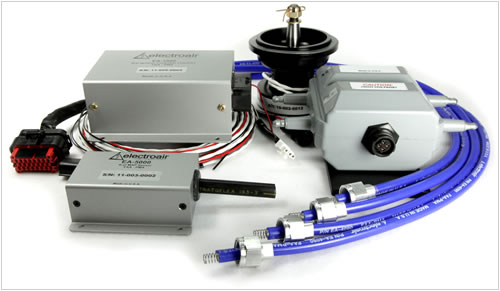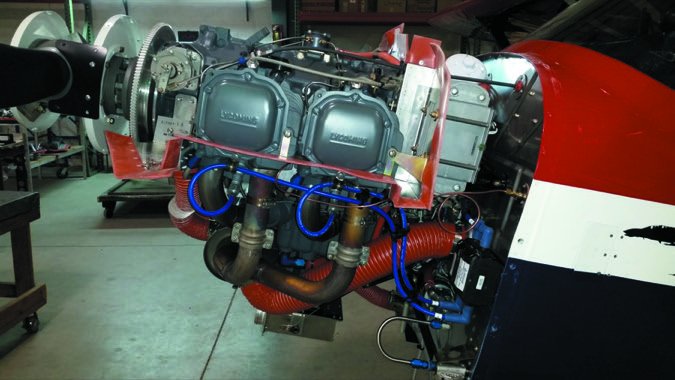
The EIS-61000 Electronic Ignition Kit is a fully STC’d kit for Lycoming 540/541/580 series, engines, installed on both single engine and twin engine aircraft. Replacing one magneto with the EIS-61000 will typically improve fuel economy on average by 10-15% (operators have reported consistent fuel savings of 1.5-2.0 gph or greater). Additionally, there will be an improvement in horsepower, smoother engine operation, easier hot starts and improved high altitude performance. The EIS-61000 adjusts spark timing automatically by way of our MAP Sensor – timing is adjusted with altitude. Most parts on the EIS-61000 are not life limited (reference the I.C.A. for recommended maintenance) – this combined with reduced spark plug fouling means lower maintenance costs. This kit can be used on either 12V or 24V systems.
Big savings to Northeast Tribe members as part of this Group Buy: EIS-61000IC, and a keyless Switch panel; plus, four (4) Massive plugs, a total of $4,449.70 (vs $4,886.50, a $436.80 savings) or (4) fine wire plugs, a total of $4,689.70 (vs $5,260.00, a $570.30 savings) The switch panel (a $269.00 item) is gratis to active duty or retired military personnel + Shipping extra.
The EIS-41000IC Electronic Ignition Kit is a fully STC’d kit for most Lycoming and Continental 4cyl engines. Replacing one impulse coupled magneto with the EIS-41000IC will typically improve fuel economy on average by 10-15% (many operators have reported consistent fuel savings of 1gph or greater). Additionally, there will be an improvement in horsepower, smoother engine operation, improved high altitude performance and better starting performance. The EIS-41000IC adjusts spark timing automatically by way of our MAP Sensor – timing is adjusted with altitude. Most parts on the EIS-41000IC are not life limited (the MTH is recommended to be changed at overhaul of the engine; spark plug wires on a regular interval) – this combined with reduced spark plug fouling means lower maintenance costs. This kit can be used on either 12V or 24V systems. Note: hand propping with an electronic ignition system is not recommended. Hand propping aircraft is a very dangerous activity and is never recommended or advisable.
Big savings to Northeast Tribe members as part of this Group Buy: EIS-41000IC, and a keyless Switch panel; plus, four (4) Massive plugs, for a total of $2,684.80 (vs $3,380.00, a $695 savings) or (4) fine wire plugs, for a total of $2,844.80 (vs $3,628.00, a $785 savings) The switch panel (a $269.00 item) is gratis to active duty or retired military personnel + Shipping extra.
SureFlys drop-in electronic ignition may not offer more power, but it has an engine-matching TBO, is easy to install and promises maintenance-free reliability.
After years of hemming and hawing, the piston aircraft engine
industry could be finally coming to its senses by embracing electronic
ignition. Electroair has been selling electronic ignitions for a couple
of years, and now SureFly—a
company stemming from Sky-Tek (starters) and Plane-Power
(alternators)—is nearing FAA certification of an electronic replacement
it calls the SIM, for SureFly Ignition Module.
I recently visited with Granbury, Texas-based SureFly for a close look at the product. Here’s a report.
Ancient History
You know, we fly some pretty darned interesting machines. They are
made as lightweight, strong and redundant as possible considering the
materials needed. If the electrical system fails, the engine will keep
running thanks to technology developed for cars in the late 1800s.
The spark plugs do their job because of the magnetos. Think of
magnetos as small generators that create electricity independent of the
electrical system by spinning a magnet in an electric field. Andre
Boudeville developed the first low-voltage mag, but the high-voltage (or
tension) magnetos were developed in 1889 by Fredrick Richard Simms and
Robert Bosch, with the addition of a coil. These created a high-voltage
spark that was needed for ignition systems in automobiles. Some used a
secondary coil to increase the voltage and some presented the charge
directly to the spark plug.
For aircraft engines, magnetos were a godsend because they were
independent of the electrical system, fairly compact and relatively
lightweight. Aircraft engines were designed with two spark plugs per
cylinder and two mags simply as a means for keeping the engine running
should one of each fail.
I once lost an alternator in a Grumman Tiger after taking off in New
Mexico. Rather than being stranded, I simply turned off the electrical
system and flew the airplane (in Piper Cub fashion) back to home base. A
rebel, perhaps, but I might not have tried this with just one magneto
on the engine.
Electronic ignition retrofits for aircraft engines have been around
since the early 1980s. Klaus Savier sold the Light Speed system starting
around 1986, and these have worked on plenty of experimental aircraft
engines—relatively problem free—for three decades. But since things in
the certified world seem to drag on, electronic ignitions haven’t gained
traction. Change could be in the air.
Costly Challenges
There are two challenges in bringing electronic ignitions to market
and in a way, they’re both related. One is a price-sensitive market and
the other is dealing with the rigors of FAA certification. The
certification effort is incredibly costly and ultimately passed down to
the consumer. Moreover, it would seem that the FAA hasn’t been exactly
welcoming of electronic ignition technology.
Developers (including SureFly) recognized this and have pursued STCs
that require the retention of the right-hand direct-drive mag (or
typically the one without the impulse coupling), while replacing the
left mag with the electronic unit. Retaining one mechanical mag retains
some system independence from electrical requirements—significantly
easing certification efforts.
Michigan-based Electroair has led the field with certified kits for
both Lycoming and Continental engines. It obtained its first AML-STC in
2011 and the list is growing. We covered the Electroair ignition in the
October 2014 issue of Aviation Consumer.
Enter SureFly
SureFly was started by the brainchildren of Sky-Tek and Plane-Power.
After selling those companies, the crew began thinking about electronic
ignitions. Jason Hutchinson, SureFly’s general manager, told me the SIM
electronic ignition (which is expected to be certified in the coming
months) was designed in only 30 days. The idea was to keep it simple,
dependable and inexpensive. Essentially, the SIM is designed to directly
replace and do what a traditional magneto does—no more. SureFly built
several prototypes and installed them on the Lycoming engine in
Hutchinson’s RV-6 and on the engine of an experimental Bellanca Viking.
Like Electroair’s system, the SureFly electronic magneto is
completely solid state. Rather than using spinning magnets and a bunch
of anachronistic parts, the concept is to electronically convert battery
power into a high-voltage signal and pulse it to the right cylinder at
the right time. Like the Electroair system, the SureFly ignition uses
standard wiring harnesses for a given engine.
The beauty of the SureFly system is its simplicity. One unit is
basically the same size and weight as a Slick mag and a couple of pounds
lighter than a Bendix. There are no moving parts, it’s fully electronic
and it requires no software updates.
The electronic mag can be adjusted to any engine’s base timing
advance (specified on the engine data plate) by a little switching
module that is accessible through a large port on the case. There is
more spark energy throughout the RPM range and the dwell is adjusted
automatically. Each spark plug has its own dedicated coil, virtually
eliminating coil failures.
There is no impulse coupling, as the unit controls timing by manifold
pressure and RPM. Below 400 RPM, the timing is set to TDC, with a
longer dwell and increased voltage, ensuring cold or even fouled spark
plug starts.
Easy Installation
The SureFly SIM is quite simple to install. According to SureFly, it
should take an experienced tech roughly an hour to install the first
one, not counting disassembly. There are no extraneous boxes or wiring
harnesses to retrofit on the engine.
A power wire, ignition switch P-lead and manifold pressure connection
are required for the installation. The engine’s RPM signal is picked up
within the module from the crank gear. Designed to last throughout the
TBO of the engine for which it’s installed on, there should be no
downtime for regular inspections, no messing with the timing or risking
the possibility of failures due to these inspections/adjustments.
As for instructions for continued airworthiness, SureFly’s SIM
installation manual advises, in part, that during the annual or 100-hour
inspection one should simply check the installation for engine oil
leaks.
During installation, power is applied to the timing lug and before
tightening the base clamps, the unit is moved slightly left and right to
ensure that the LED indicator is off. The power lead is then moved to
the power post and the engine is ready for ground running.
Versus Electroair
SureFly is expecting to have FAA certification for its SIM before
this coming summer. The SIM for four-cylinder engines will have a list
price of $1250 and the six-cylinder SIM will cost $1550. Dealer
discounting is possible. With disassembly, reassembly, paperwork and
testing, typical labor costs should be well under $500—which is a real
savings. The other savings, compared to traditional magnetos, is not
having to pay for teardown and inspection.
But understand that the SIM doesn’t have unlimited life. Overhaul
pricing hasn’t been determined, but there are simply two bearings and
one drive shaft in the four-cylinder version and two additional bearings
for the six-cylinder version. That could keep overhaul costs low.
Once the SureFly SIM is certified, buyers will have to choose between
it and the Electroair ignition. The Electroair has a starting street
price of around $1600 for four-cylinder engines and as high as $2500 for
some six-cylinder engines. List pricing is considerably higher. The
Electroair system is designed to last until the TBO of the engine.
If performance gains are the motivating factor, buyers will likely be
drawn to the Electroair system because it has variable timing, which
offers more power and better fuel efficiency. Electroair began
development of its six-cylinder model in 2012, and has since received
certification of the EIS-61000 system for large-bore Continental
engines.
The SureFly SIM was not designed for performance enhancements,
although some fuel efficiency is expected. The whole idea was to offer a
dependable, low maintenance, stone simple electronic ignition that can
be sold for a reasonable price. Remember, too, that SureFly’s SIM will
be certified for basically all four- and six-cylinder engines
immediately, due to the ability to adapt a common module to every four-
or six-cylinder engine.
As it goes in all fields of endeavor, the last guy to bring something
to the table has all of the first guys to learn from. In my estimation,
the SureFly crew is a sharp bunch, they are all pilots and aircraft
owners and they are all thinkers. They’ve had a proven track record of
success from the get go, including their unabashed modification of
automotive starters for aircraft application. After all, if it works,
why redesign the wheel trying to change it?
For simplicity and for saving space in the engine bay, plus saving
weight and reducing installation cost and complexity, the SureFly SIM
could be the best choice for an electronic ignition retrofit. On the
other hand, it isn’t FAA certified yet, which—for now—gives Electroair a
sizable advantage.
When he’s not drumming in his band Revolushn, contributor Jim Cavanagh flies and wrenches several of his own aircraft.