Category: Comanche

  • Expensive Engine replacement? – Hang-on, not so fast

    Expensive Engine replacement? – Hang-on, not so fast

    A member just avoided an expensive engine replacement after it appeared, she had metal in the engine oil, and an (incorrect) assumption of low oil pressure by the A&P.  Kudos to the owner for keeping her cool, and to the Northeast support team (Zach Grant and Eric Kenyon).  The low oil pressure was checked with a calibrated gauge and found to be normal, and the Lycoming service letter and knowledge base guidelines were presented and are now being followed by the A&P. As Lycoming said, “The lack of printed matter on this subject may be due to the difficulty in adequately describing types and amounts of metal. It’s like asking for a precise measurement and getting the answer, “why it’s 25-thousandths plus a little bit.”  As this is the second engine this month that almost has a premature condemnation, we link to the two documents above.  While metal in the filter is never to be ignored or taken lightly, it is not a death knell and, in some circumstances, it is expected.  There are also things that will closely resemble metal, such as carbon deposits.  In both cases, a second opinion was warranted and saved many $$$ and time..    —- Hopefully we can publish a long article so that other owners will benefit should a mechanic similarly jump to conclusions without an investigation of the facts

  • Bird Strike

    Bird Strike

    One clear December Morning in 2000 I was flying at 500 AGL south of JFK over the ocean when I encountered a flock of seagulls. When I turned on my landing lights, which I’m told is to help the birds see the plane, all but one missed me. Apparently, no one told him why my landing lights were on.

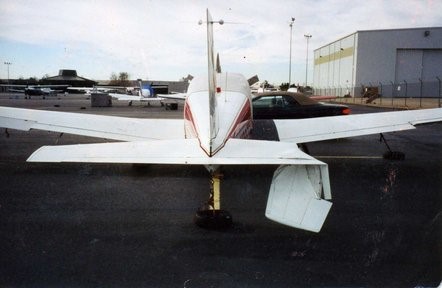
    A big, brown and white garbage seagull came over the passenger wing and slammed into the right stabilator. I’m not

    sure of his airspeed, but I was doing between 155 and 160 knots.

    The impact, coupled with the airspeed, took out the outer half of the right stabilator. The impact was so intense that the left stabilator and trim tabs were also bent, and I later learned that three of the four stringers holding the tail on were torn off. The remaining stringer had only half of the rivets remaining.

    The aircraft immediately went vertical

    By pushing forward with all my strength, I was able to regain control of the aircraft and then began to use my skill, knowledge, experience and luck to slowly reduce power so I could maintain control. It wasn’t easy and required constant forward pressure.

    I was now the test pilot for my 1966 Piper Comanche. I began to ascertain the damage to find out what I had left.

    “By pushing forward with all my strength, I was able to regain control of the aircraft”

    I slowly tried the roll input and yaw; both were as they should be. Obviously, I knew I had elevator to go up, but not down. The engine was still producing power so I decided not to declare an emergency. I informed ATC of the predicament, refused to land on the beach or at JFK and continued flight for another 20 minutes to Republic Airport in Farmingdale, N.Y. (FRG).

    Keeping in mind that from the pilot seat there was unknown damage to the tail, gear was left up as were flaps, until over the threshold at which time gear was extended and flaps left retracted. I didn’t know how close to the stall I was operating, nor landing, so all inputs were slow and pre-determined.

    The decision to wait until I got to the runway before making any changes to configuration of the aircraft was simple. I’d rather crash at a lower altitude on the airport where the help was, than miss it and have to wait for help. Landing was uneventful, except for the emergency trucks the tower had called out on their own, and the tower telling me I was missing the last three feet of the stabilator.

    I taxied to my tie down spot and got out to see just how extensive the damage was. That was the first time I actually

    saw it. I think that’s when I got a little rush.

    I filled out a bird strike report and went home. What was I going to tell my wife? I figured I wouldn’t tell her and maybe she wouldn’t notice the damage or we weren’t going flying for a few months. I thought better of that idea. Her reaction was pretty calm which led me to believe that she didn’t love me that much. I was wrong about that too as later that afternoon I borrowed my friend’s Comanche to fly to Connecticut and she thought I was crazy.

    When I returned later, I found the friendly FAA had put a condition notice on the airplane telling me I shouldn’t fly the airplane in its condition. (What would we do without this valuable input? Like I would fly it in its current condition.)

    The FAA also wanted to see the aircraft logs regarding the maintenance prior to the accident.

    I have saved the tapes of the communication from New York approach and FRG. As I said, some people, my wife for one, thought I was crazy for flying again, let alone the same day. “How can you go flying again after that?” I figured, what were the odds of it happening twice in the same day?

    The photos show the extensive damage and the strength of our airplane. Even sick and limping, it got me home. I have been flying my Comanche since 1978. I have accumulated almost 5,000 hours and approximately 4,000 are in the Comanche.  There still is no better airplane flying, nor more fun to fly.

    Editor’s note: I would not intuitively know what do in similar circumstances. But, having survived a fuel outage on takeoff which destroyed our original plane, I believe it is so important to learn from others experiences. Erik Sacks will be speaking at one of our fly-in’s

  • Lobsters in the Cockpit, a tail

    Lobsters in the Cockpit, a tail

    Dark. Turbulent. Rain. In the clouds. Changes in my route clearance from La Guardia Approach Control as fast as I could write them down and faster than I could execute them. This was single pilot instrument flying at its busy-as-a-one-arm-paper-hanger worst.

    There was only the dim red glow of the cockpit lights to give me cheer that Friday night as I started home from the Hampton Airport on Long Island to Washington, D.C. in my single engine Comanche.

    The voice of the Controller was a continuous staccato barrage in my headphones as he directed me and at least thirty-eleven other airplanes through the stormy New York City weather. I have been given two changes in my flight plan clearance sitting on the end of the runway and another as I lifted off the runway. Not three minutes later, they were changed yet again and I was to the point of making rash promises to God that I’d never fly alone in bad weather again.

    Suddenly, I glimpsed a movement out of the corner of my eye! On the floor, in front of the empty copilot’s seat, there were two claws waving back and forth and moving towards my right leg! The only thing that prevented a severe dent in the roof of the cockpit was the seat belt which limited the height of my jump. There was something alive in my airplane, and it was after me!

    Now they say that in moments of great stress one’s life flashes through one’s mind. What flashed through my mind was that time in my youth when I got locked in a barn with a skunk; I don’t know which one of us wanted out the worst.

    I pushed my seat back, reached for the flashlight, lifted my legs, and yelled loud enough to be heard down on Broadway. Needless to say, the airplane was doing its own thing while I was doing mine, which was not exactly in accordance with the Approach Controller’s most recent instructions.

    Bill Jackson

    There on the floor staring balefully back at me in the beam of my flashlight was an obviously displeased and highly agitated two-pound lobster.

    Now the reader may wonder just how did a live lobster come to be hitching a ride in a Comanche on a stormy Friday night? I knew how come, but what I did not know was why in the world I ever had such an unbright idea to start with.

    It all began the day before while returning from a Boston to New York business trip in the Comanche with my attorney. He mentioned that his family was on Long Island in their summer house and that if we were to go to the Hampton Airport and call his wife, she would pick us up and we could enjoy a lobster dinner. Afterward we could continue to Teterboro, where I temporarily based the airplane, and thence back into New York City where we worked Monday thru Friday.

    We did. It was a feast fit for royalty. I was so enthusiastic in my praise for the wonders of such a dinner that my hostess offered to obtain a bagful of lobsters for me the next day. I could fly over and pick them up in the evening while enroute to my home in Washington, D.C.

    I did.

    They were in a plastic bag, and it was raining, and I was in a hurry to be gone. And I really didn’t notice that they had no pegs in their claws to keep them harmless when I put the bag on the floor behind my seat.

    Now a good sense of humor, nor a high level of patience, are not required by the FAA in their personality profile criteria for controllers. Accordingly, I was advised in no uncertain terms that I was 30 degrees off assigned heading and 300 feet below assigned altitude.

    I acknowledged the rebuke and set about straightening up the airplane while keeping a wary eye on my antagonistic passenger, who had clearly decided that there wasn’t enough room in that airplane for the both of us.

    Amazingly agile that lobster, and very quick and once free of captivity, quite determined to stay that way. Furthermore, he was totally willing to do bodily harm to anyone who disagreed with his position on the matter. He got me twice before I managed to get hold of him long enough to throw him as far back to the rear of the airplane as I could. I then blocked his counter attack with my flight kit.

    This time the Controller not only advised me of my wandering ways, but wanted to know if I was rated for instrument flight. I meekly told him that I was and that I had had a small problem which was okay now. Famous last words.

    Lobsters, I quickly learned, belong to a mutual protection society. Not only that, they are sneaky. I wasn’t aware of the next attack until I had become a casualty of it. Lobster Number Two, taking a lesson from Lobster Number One, gave no warning before he provoked another screech from me, the result of his attaching himself to the calf of my right leg.

    As we broke off that engagement, I reviewed his ancestral indiscretions quite vehemently and before finally sending him on a short trip to join his friend in the baggage compartment. How many damn lobsters were still in that bag?

    The Approach Controller by now was becoming a candidate for an early medical retirement. He not only pointed out that my erratic flying was probably a good reason for staying out of New York airspace in the future, he also really wanted to know what exactly was my problem. In fact, one would say that he was somewhat insistent.

    So, I told him.

    There was a rather long silence on the headphones. No doubt every other pilot listening on the radio frequency was waiting to hear what would come next. It was a classic. “Sir”, he said, “what are your intentions?”

    Well, I had all sorts of intentions. I had intentions on staying alive. I had intentions on catching the rest of those lobsters before they caught me, and I damn sure had intentions for what to do with those lobsters if and when I got them home. However, all things considered, it seemed like the best thing for me to do was declare an emergency and then to do battle with the remaining lobsters in (or by now, out of) the bag.

    The Controller and I had some discussion then over the nature of my emergency, (lobsters loose in the cockpit?) followed by the inevitable telephone number for me to call should I ever land in one piece (Big Brother Bond would want to hear about this!). Then he finally gave me a vector out over the water where I could wander about in the soup at will during my great lobster crusade.

    To the accompaniment of sly suggestions by other anonymous pilots on the frequency to “ride’em cowboy” and “boil ‘em in oil”, I headed east out over the Atlantic and for a while it was everything but “shiny side up”.

    After landing in Washington I was on the phone to three different FAA supervisors for over an hour before I finally convinced them that I was neither drunk, crazy, incompetent nor illegal and that I would definitely file a written report of the incident.

    Near midnight, I had my sweet revenge when I dropped those lobsters, one at a time, into the pot and watched them turn a bright red. They were scrump-dilly-iscious

  • Comanche 250 Review

    Comanche 250 Review

    The Comanche was conceived in the late ’50s when Piper and the rest of the industry was playing catch-up with the premier four-seat retractable, the Beech Bonanza. Piper’s Comanche was introduced as both a 180-hp and a 250-hp model, sporting four- and six-cylinder versions of the same engine. The former was planned to compete with Mooney’s wood-wing and tail Mark 20A, the latter with Beech’s successful V-tail, along with the dark horse Bellanca 260 and Meyers 200.

    “There are a few airplanes that deserve better than they got.
    The Comanche 250 is one of them”

    The Comanche was remarkably successful, selling almost 1,000 units in the first 18 months. The PA-24 would evolve to fuel injection, turbocharging and even an additional 150 hp, but sadly, its production run would be cut short by a natural disaster. In 1972, the Susquehanna River that ran through Lock Haven, Pa., a few hundred yards southeast of the Piper plant, overflowed its banks and flooded the airport and the Piper production facilities. The Comanche’s tooling was ruined when the river put the Piper plant underwater, forcing the company to discontinue production of the Comanche and Twin Comanche. When it was all over, Piper had built nearly 7,000 Comanches of all varieties in 15 years of production, impressive, although not spectacular by the standards of the 1970s.

    For some pilots, however, the first Comanche was perhaps the best. Twenty-five years ago, a good friend who loved his pristine 250 Comanche died unexpectedly in his sleep, and his wife couldn’t bear to sell her husband’s beloved airplane. I wound up with a set of keys and a directive from the wife to fly the Comanche whenever I wished. I put probably 70 hours on the Comanche 250 during the next year and came to respect the airplane as a wonderful people mover. Jack’s widow finally sold the Comanche 18 months after his death, and I was sorry to see it go.

    Robert Wall, a USAF retiree from Ocala, Fla., purchased his 1958 Comanche 250 in 1983, and he’s not liable to sell it anytime soon. Wall’s Comanche is technically only his third airplane, but he has flown a little of everything during his professional flying career.

    “I got my private license in 1947 and almost immediately bought a surplus BT-13 for $450 as my first airplane,” says Wall. “The old Vultee Vibrator had been assembled by a WWII pilot from the best parts of three BT-13s, so it was a reasonably good airplane, but it was expensive to own and operate, even in those days.“

    In search of better economy, Wall went to the opposite end of the scale and purchased a Culver Cadet in 1953. He flew the Cadet until 1956, then sold the little Culver and didn’t buy another airplane for nearly 30 years. He had plenty of other airplanes to fly, however. In the late ’50s, Wall became the chief pilot for Sky Roamers, a co-op flying club with 250 members and 22 airplanes based in Burbank, Calif. In 1958, when Sky Roamers was considering stepping up to its first retractable model, Wall supervised a fly-off between a 1957 H35 Bonanza and a 1958 Comanche 250.

    “We were looking to buy four retractables, so the stakes were pretty high. We decided to test the two representative models available at that time. On paper, the airplanes were pretty evenly matched, 240 hp in the Bonanza, 250 hp in the Comanche,” says Wall. “We decided to fly an out-and-back from Burbank to Phoenix with four people in each airplane and fuel to gross weight.

    “The Comanche was the winner in almost every category hands down,” reveals Wall. “Everyone loved the way the Bonanza handled, but the Comanche out-climbed the Bonanza at all altitudes and out-ran it at all power settings. I was impressed. Eventually, the club wound up buying four Cessna 210s instead of the Comanches, and that turned out to be a big mistake.”


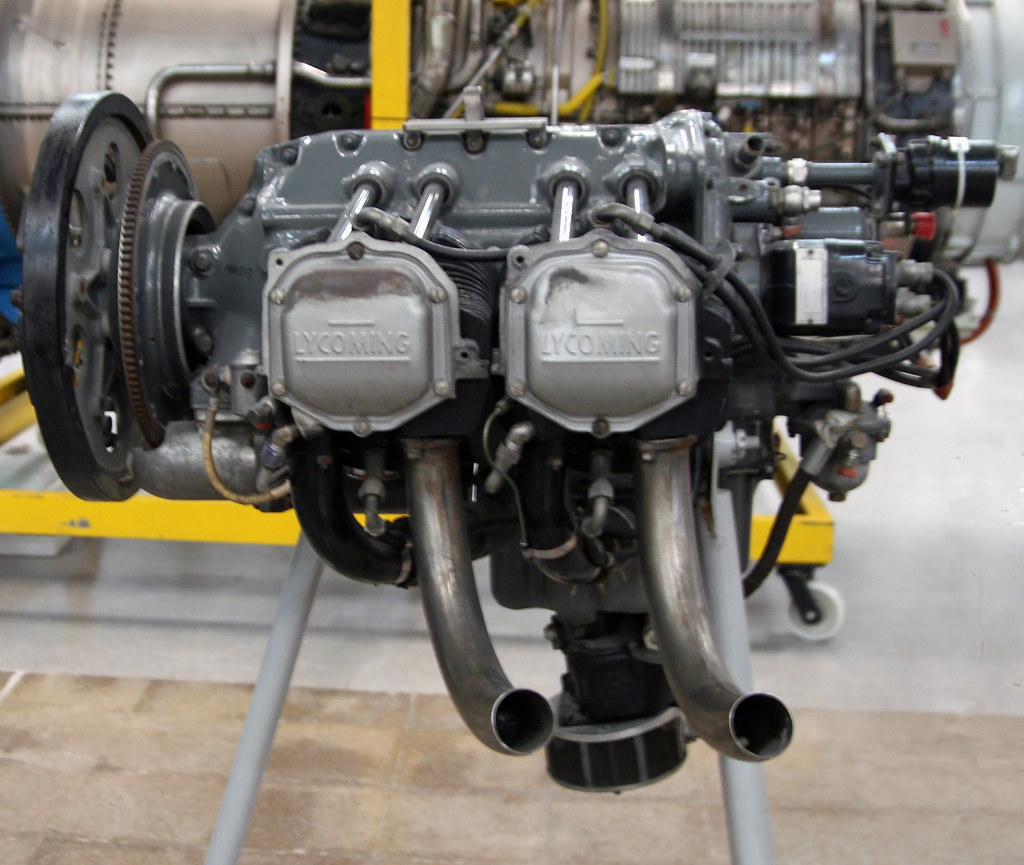
    One of the reasons for the Comanche’s success was simply its laminar-flow wing, a remarkable compromise between high speed and high lift. Specifically, the wing is a NACA 64(2)-A215 airfoil with five degrees of dihedral. Another feature that made the first Comanche popular was the carbureted, 540-cubic-inch Lycoming engine that was to evolve to a 2,000-hour TBO. It’s a fairly simple mill, carbureted for easy starts, underworked and happy to deliver full power forever if you need it.

    Climbing up onto the wing is a short step, as the airplane’s oleo gear snuggles close to the ground. In fact, the low stance is a common complaint of some pilots who tend to flare high and drop the airplane in during landings. The Comanche’s cabin was well-fitted for crew and passengers, a reasonable enclosure measuring 44 inches across by 43 inches tall, more than coincidentally, wider than any of the competition.

    By today’s standards, the early Co-manche’s panel looks like something out of a South American locomotive, with instruments and switches scattered seemingly at random around the panel. Wall has updated his airplane’s radios and instruments to more modern equipment, but he has retained the original configuration for the sake of authenticity.

    Wall’s Comanche is one of those airplanes we love to test here at P&P, a nearly half-century-old machine that could have been built last month. The owner is an A&P mechanic who does most of his own maintenance, and he’s convinced the Comanche is one of the easiest general-aviation airplanes to work on, especially from the firewall forward. Accordingly, the owner has overhauled the Lycoming engine, rebuilt the gear, replaced the windshield and all the side Plexiglas and reupholstered the interior. Throughout the ground-up rebuild, he has tried to remain true to the original configuration whenever possible. “I’ve been through every system in the airplane,” laughs Wall, “so if anything breaks, I have only myself to blame.”

    Wall’s son, Jack, an American Airlines 737 pilot, painstakingly researched the paint scheme, and Ada Aircraft in Ada, Okla., did the meticulous strip and paint job that resulted in the authentic 1958 scheme.

    The finished product was about as close as it was possible to come to an all-original 1958 Comanche 250, and it’s interesting to contrast how that airplane compares to the competition of the time.


    Compared to most airplanes of the era, the Comanche 250 was a relative economy model. It’s important to remember this was the ’50s when the CPI was about a seventh of what it is today. The Comanche did essentially the same job as the others at an acquisition cost of $5,000 to $7,000 lower. What cost $7,000 in those days is priced more like $50,000 in 2005. Some buyers probably found the Comanche’s 20% to 25% lower sales price compelling.The comparison chart suggests the Comanche’s cruise is the slowest in the class, but Wall feels the gap may be considerably narrower in the real world, as speeds for some of the other models are probably overstated. It’s interesting to note that even today, most modern production airplanes of comparable horsepower don’t fly much faster than the Comanche.

    With well over a thousand hours in the PA-24, Wall acknowledges the 1,350-fpm climb spec is little more than a PR man’s dream; 1,000 fpm is more like it, but the quoted cruise number is accurate. “I’ve run the Comanche at max cruise several times, and it seems to do pretty much what Piper claimed for it, 158 knots or so at 6,500 feet,” explains Wall.

    The owner doesn’t push his airplane at 75% most of the time, however. He prefers to throttle back to whatever power will yield 140 knots.

    “I like to fly as high as possible, and the Comanche does that well,” says Wall. “I’ll typically climb to at least 10,500 feet, perhaps even 11,500 or 12,500, strap on an oxygen mask and cruise at about 2,000 rpm and all the manifold pressure I can get. That usually allows me to see a true airspeed of 140 knots on a little over 10 gph.”

    Later Comanches offered as much as 90 gallons in long-range tanks, but the first 250s, Wall’s included, were limited to 60 gallons. That means Wall can fairly easily plan on slightly more than four hours of endurance plus reserve, enough to traverse nearly 600 nm at a sitting.

    Like those who have flown Comanches and learned to appreciate their talents, Wall’s only disappointment is that there’s nothing left to do. He’s convinced the Comanche 250 was the best of its vintage, and he’s determined to keep it for, oh, probably the rest of his life.

  • AOPA Fly-in

    AOPA Fly-in

    The AOPA fly-in was a success! Special huge thanks to Ray Burton, and his family (this was their 15th anniversary and they supported ICS!), Pete Morse, Bernie Stumpf, and the many ICS people who stopped by to say hello and stayed to talk. We even had a surprise visit from a very supportive FSDO official (even if it made Ray a bit nervous to see a guy standing next to his open cowling with an FAA badge in plain sight)! It was a long but productive 2 days.

    As you can see from the location, the management at Groton was very supportive of the Comanche type! The airport manager and AOPA fly-in coordinator also stopped by several times to thank us for our past support and also to ask us if we liked our nice location.

    “AOPA fly-in coordinator stopped by several times to thank us for our past support”

    The AOPA gathering was extremely well-run and had a huge attendance, we think we had over 100 visitors the first day and more the next. Everyone looked at Ray’s handily rescued and well-flown bird and learned about why they are great and why we love them.

    Two suggestions:
    1) I’d recommend a sign-in book such as Oshkosh has that can go with the materials. That way we can track results and people will have a place to write requests for more info or followup as well as suggestions.
    2) I’d request the committee to reconsider its refusal to provide cards to the volunteers and not just the display owner. The current situation causes confusion. I looked back in my notes and the basic cards are $5!
    3) we found the website to be unusable for signing up new members. The northeast version demands payment info without ever even asking for their contact and airplane information. This means we missed some new members who wanted to sign up. For the last new member, mystic jet center was kind enough to print me out a sign-up form. There I found another problem: we are using a different annual price on the form versus the website. Hope we can resolve these things ASAP.